Published: December 17, 2025 • 14 min read
When people say “AI” they often mean “a model that writes plausible sequences.” In practice, that could mean anything from a 2‑gram Markov chain to a GPT‑style Transformer. They’re all probabilistic sequence models, but they differ radically in:
- what conditional independence assumptions they make,
- how much context they can effectively use,
- how they’re trained,
- and how they’re decoded at inference time.
If you don’t have a math background, you can still follow along. The mental model you need is simple:
- A model reads what you’ve already written.
- It assigns “next-step odds” to many possible next tokens (a token can be a word, syllable, MIDI event, chord symbol, etc.).
- A decoding strategy chooses one token from those odds.
The rest of this article is a tour of three ways to build that “next-step odds” machine, from simple to powerful.
A tiny glossary
- Token: the unit the model works with. In text it might be a word piece; in music it might be a chord symbol, a note-on event, a duration, or a “bar line.”
- Context: the tokens the model is allowed to look at when predicting the next token.
- Context window: the maximum context length a model can use at once.
- Model: produces a ranked list / odds for “what comes next.”
- Decoding: the rule you use to pick the next token from those odds.
The common core: “predict the next token”
All three approaches (Markov chains, LSTMs, GPT) share the same outer loop:
- read the tokens so far
- score what could come next
- pick one
- append it
- repeat
Here’s that loop as a diagram:
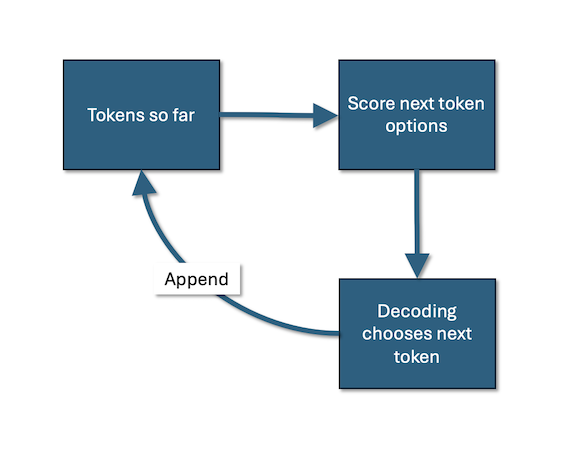
So when people argue about whether something is “real AI,” they’re often mixing up two separate things:
- The model: how it computes those next-token scores.
- The decoding: how you turn scores into an actual output sequence.
If you like tables, here’s the whole article summarized up front:
| Family | What it “remembers” | Strengths | Typical failure modes |
|---|---|---|---|
| Markov / n‑gram | A fixed-size recent window | Simple, fast, works well for local grammar | Forgets long-range structure; sparse data issues |
| LSTM | A learned rolling memory | Good at style and medium-range patterns; efficient at inference | Memory bottleneck; can drift; training can be finicky |
| Transformer / GPT | Learned attention over many prior tokens | Strong long-range structure; scales well with data/compute | Expensive; context-window limits; can be confidently wrong |
Markov chains and n‑gram language models
The Markov idea: “only the recent past matters”
A Markov chain is the simplest story you can tell about sequences:
- Look back a little (often just 1 token, or a small fixed window).
- Pick what usually comes next.
In language terms, an n‑gram model looks at the last n-1 tokens.
- a 2‑gram (bigram) looks at the previous token
- a 3‑gram (trigram) looks at the previous two tokens
This “fixed window” is both the superpower and the limitation:
- it’s fast and easy to understand
- but it has a hard memory cutoff
If the “reason” a token should appear depends on something that happened 30 tokens ago, a 5‑gram simply can’t see it.
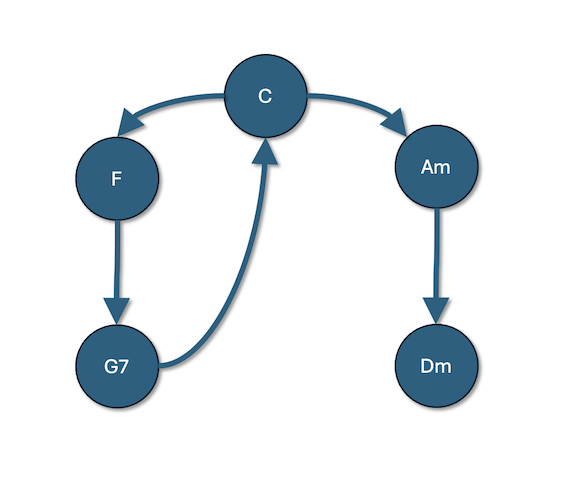
One helpful way to picture a Markov model is as a map of “common next steps.” If you’re generating chord symbols, your map might strongly connect:
C->FC->AmG7->C
In the simplest form (a first-order Markov chain), you’re literally moving along a graph of transitions:
Training by counting (with a reality check)
Training an n‑gram model is basically counting.
You scan your dataset and build a table like:
- after “Cmaj7” you saw “Fmaj7” 120 times
- after “Cmaj7” you saw “Am7” 80 times
- after “Cmaj7” you saw “Db7” 2 times
Then at generation time, you turn those counts into “odds” and sample.
The practical problem is that real data is sparse:
- many reasonable sequences never appear in your dataset
- a lot of contexts appear only once
So n‑gram systems usually add “smoothing/backoff” tricks that say, roughly:
- “If I’ve never seen this exact context, fall back to a shorter context.”
That’s why Markov/n‑gram models can feel surprisingly coherent for short stretches:
- they’re great at producing things that look like the training data locally
- but they don’t have a mechanism for global intention
Why n‑grams are not “dumb,” but are limited
n‑grams can be surprisingly strong for certain symbolic tasks (including some music tokenizations) when:
- local syntax dominates (short-range dependencies), and
- the vocabulary is small.
But they struggle when you need:
- long-range structure,
- hierarchical patterns,
- global constraints,
- “themes” that recur after long spans.
Reference:
- Markov chains: https://en.wikipedia.org/wiki/Markov_chain
- n‑gram LMs: https://en.wikipedia.org/wiki/N-gram
LSTMs: learned state as a compressed summary of the past
The upgrade over n‑grams: a learned “memory”
An LSTM is part of a family called recurrent neural networks (RNNs). The big conceptual jump is this:
- instead of a hard cutoff (“only the last 4 tokens matter”)
- the model carries forward a rolling summary of everything it has seen
You can picture it like reading a story while keeping notes.
- At each new sentence, you update your notes.
- When you predict what happens next, you use those notes.
That “notes” object is a bunch of numbers inside the model (a learned memory).
Two important implications:
- there is no hard cutoff like an n‑gram window
- but there is a bottleneck: the notes have fixed size
Why “plain memory” is tricky (and what LSTM fixes)
If you try to learn long-range patterns with a simple RNN, the training signal has a habit of fading away as you look further back in time.
You don’t need calculus to understand the vibe:
- learning depends on many small step-by-step influences
- multiplying a lot of small influences often becomes tiny
So the model becomes great at “recent context” and forgetful about “things from long ago.”
LSTMs were designed as a practical fix.
LSTM in one sentence: controlled remembering
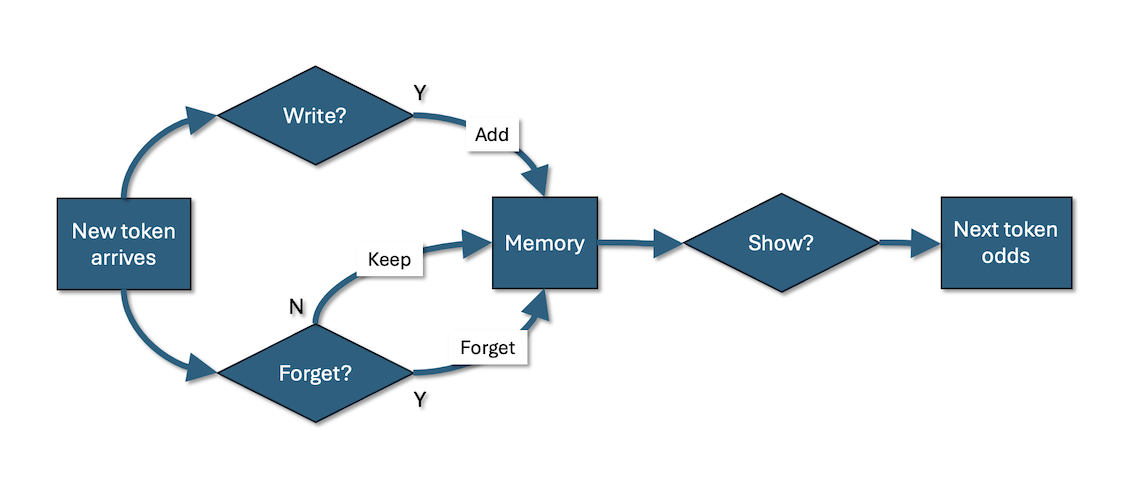
An LSTM adds a more explicit memory mechanism with “gates” that behave like dials:
- forget: what should I erase?
- write: what new thing should I store?
- show: what part of my memory should influence the next-token choice?
If you want a visual intuition, it’s closer to a tiny state machine than to a simple sliding window:
Historically, LSTMs were the workhorse for sequence generation for years (text, MIDI, audio feature sequences) because they hit a nice practical point:
- decent long-range behavior without the quadratic attention cost
- efficient “one step at a time” decoding
But they can still drift over long generations: if the internal memory loses the plot, there’s no easy way to “re-scan” the entire earlier context.
Training and decoding (still the same outer loop)
From the outside, LSTMs still do the same thing as n‑grams:
- training: learn to assign high odds to the “correct next token” in your dataset
- generation: turn those odds into actual tokens using a decoding strategy (greedy, sampling, top‑p, etc.)
Reference:
GPT/Transformers: attention over all previous tokens
Decoder-only Transformers
GPT-style models are decoder-only Transformers trained to predict the next token, just like the other approaches.
The difference is how they use context.
- LSTM: compress the past into a single “memory” vector
- Transformer: keep representations for many past tokens and learn where to look
Self-attention (the core operator)
Self-attention is easiest to understand as a “spotlight.”
When generating the next token, the model can look back over the earlier tokens and decide:
- which earlier token(s) matter most right now?
- how should I combine them?
It does this for every layer and learns the “looking” behavior from data.
For a high-school-math mental model:
- every previous token gets a relevance score
- those scores become weights that add up to 1
- the model takes a weighted average of information from the past
Here’s a sketch of the idea:

Two practical notes that complete the picture:
- Position matters: the model needs a way to tell “this token was 3 steps ago” vs “300 steps ago.” Transformers add a positional signal so order isn’t lost.
- Context windows are real limits: a Transformer can only attend over the tokens it’s given. Outside the context window, it can’t “see” anything unless you re-provide it (or use retrieval).
Why Transformers scale differently than LSTMs
-
Context access:
- n‑gram: a fixed small window
- LSTM: theoretically long, but filtered through a single memory bottleneck
- Transformer: can directly reference any earlier token within its context window
-
Why that matters:
- Transformers can learn patterns like “echo something from earlier” or “match a structure introduced 200 tokens ago” more naturally.
- They also train very efficiently on modern hardware because many operations can happen in parallel.
KV caching at inference
Autoregressive decoding with Transformers typically uses a key/value cache so each next token step does not recompute attention over the full prefix from scratch.
What “GPT” adds beyond architecture
“GPT” is a bundle of:
- decoder-only Transformer
- large-scale training data
- next-token prediction objective
- careful optimization, regularization, and scaling
- decoding heuristics (temperature, top‑p, repetition penalties, etc.)
In modern usage, “GPT-like” systems often add a few more ingredients that people feel as “intelligence,” even though the core training objective is still next-token prediction:
- Scale: bigger models trained on more data tend to pick up more abstract patterns.
- Instruction tuning: extra training so the model follows prompts like “Explain this” or “Write in this style.”
- Preference tuning / RLHF (or similar): training that pushes outputs toward what humans rate as helpful/safe.
- Tool use: the model can call external tools (search, calculators, code execution) and incorporate the results.
- Retrieval augmentation (RAG): fetch relevant docs from a database and include them in the context so the model can quote and ground its answers.
Those additions are a big reason a modern chat model feels different from “a random text generator,” even though the underlying generation mechanism is still: predict-next-token, repeatedly.
References:
- Attention Is All You Need: https://arxiv.org/abs/1706.03762
- GPT-2 paper: https://openai.com/research/language-unsupervised
Decoding ≠ training (and why this matters for “AI” claims)
This is the part that trips people up.
Two systems can share the same trained model and still produce wildly different output, because decoding is an extra decision layer.
- Training teaches the model to produce sensible “next-token odds.”
- Decoding decides how bold, safe, repetitive, or diverse the final output is.
Even a strong model can generate junk if you decode poorly (too greedy, too random, no repetition controls, etc.).
In other words:
- training is “how the model learns what seems plausible”
- decoding is “how adventurous you want the output to be”
Common decoding strategies:
- Greedy: fast, deterministic, can be repetitive
- Beam search: approximates the MAP sequence
- good for constrained objectives, but can reduce diversity
- Sampling (temperature, top‑K, top‑p): increases diversity
Reference:
- Beam search: https://en.wikipedia.org/wiki/Beam_search
How this maps to music generation
Symbolic music is unforgiving: a single invalid token can break structure.
Also: music often has multi-scale structure:
-
local: voice-leading, chord-to-chord motion
-
medium: phrase shapes, cadences
-
global: form, motif return, tension/release arcs
-
n‑grams capture local grammar (e.g., common chord-to-chord transitions), but cannot enforce global constraints.
-
LSTMs learn “style” well and can work with compact models and small vocabularies.
-
Transformers are extremely strong at long-range structure but are typically heavier to deploy inside real-time plugin constraints.
A practical pattern is a hybrid:
- use an autoregressive model (LSTM or Transformer) for what happens next,
- then apply a separate structured search/constraint system for how to realize it (e.g., voice leading), which may use beam search for a completely different reason than text decoding.
This is why you’ll sometimes see “AI music” systems that combine:
- a learned generator (n‑gram/LSTM/Transformer)
- plus explicit musical rules or a scoring function
It’s not cheating; it’s engineering.
So… is it AI?
If “AI” means “systems that learn statistical structure from data and generalize,” then:
- n‑grams are already “AI” in that sense.
- LSTMs and Transformers are more expressive function classes trained the same maximum-likelihood way.
If “AI” means “human-level reasoning,” that’s a different claim entirely, and it does not follow from next-token prediction alone.
If you want a simple way to complete the picture:
- Markov chains answer: “What tends to follow what, locally?”
- LSTMs answer: “What’s a useful compressed memory of the past?”
- Transformers/GPT answer: “Where should I look in the past, right now, and how should I combine it?”